
Why Lubricant Testing Matters: Key Laboratory Tests Explained
Discover six important laboratory tests, what they measure, and how scientific analysis supports lubricant quality, formulation development, and informed equipment maintenance.
Why Is Lubricant Testing Important?
Two lubricants may look identical, yet perform very differently under real operating conditions.
Lubricants protect machinery by reducing friction, controlling wear, and supporting reliable operation. However, appearance alone cannot confirm whether an oil meets its required specifications.
Laboratory testing provides measurable information about lubricant quality, performance, and condition.
It helps manufacturers evaluate formulations, maintain consistency, and identify potential problems during equipment operation.
Six Key Lubricant Laboratory Tests
Different tests reveal different properties. Combining relevant measurements provides a better understanding of lubricant characteristics and condition.
Viscosity Testing
Measures resistance to flow and helps verify lubricant viscosity characteristics.
ASTM D445 Learn More 02Flash Point Testing
Evaluates flash point under controlled conditions and helps characterize volatility.
ASTM D92 Learn More 03Pour Point Testing
Characterizes low-temperature oil flow under standardized conditions.
ASTM D97 Learn More 04Oxidation Stability
Helps assess a lubricant's resistance to oxidative degradation.
Application-dependent methods Learn More 05Wear Testing
Evaluates wear-preventive properties under specified mechanical conditions.
ASTM D4172 Learn More 06Particle Counting
Measures suspended particles and supports cleanliness monitoring.
ISO 4406 classification Learn MoreUnderstanding Oil Flow
Viscosity measures a lubricant's resistance to flow and influences its ability to form a protective film between moving surfaces.
Laboratories commonly measure kinematic viscosity at 40°C and 100°C using ASTM D445, with results expressed in centistokes (cSt).
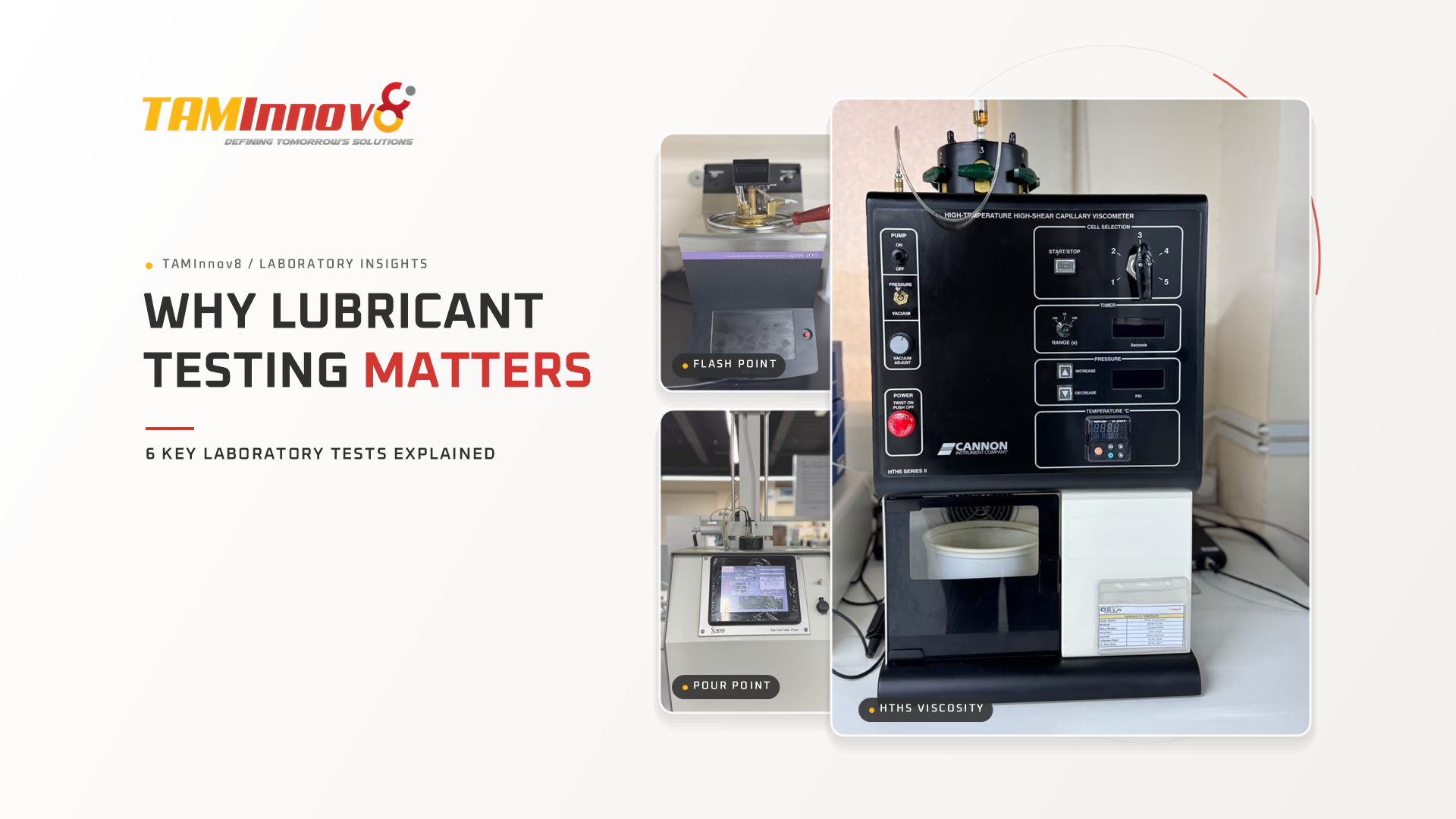
The pictured Cannon instrument is a high-temperature high-shear (HTHS) capillary viscometer. HTHS measurement and ASTM D445 kinematic viscosity are different tests.
Viscosity testing helps verify lubricant grades, supports quality control, and can identify changes associated with degradation or contamination.
Evaluating Lubricant Volatility
Flash point is the lowest temperature at which a liquid produces enough vapor to ignite momentarily under specified test conditions.
The ASTM D92 method uses a Cleveland Open Cup apparatus to evaluate suitable petroleum products.
Flash point testing supports product characterization and quality control. An unexpected reduction in a used lubricant's flash point may indicate contamination by more volatile substances.
Assessing Low-Temperature Flow
As temperatures decrease, lubricants can become increasingly resistant to flow. This may affect their movement through lubrication systems.
Pour point testing using ASTM D97 determines the lowest temperature at which oil movement is observed under specified test conditions.
Pour point testing helps characterize low-temperature flow properties and supports lubricant selection. Additional tests may be necessary to assess actual pumping performance.
Measuring Resistance to Degradation
Heat and oxygen can gradually degrade lubricants, potentially increasing acidity, changing viscosity, and contributing to deposit formation.
Oxidation stability testing helps evaluate how well a lubricant formulation resists these changes. For example, ASTM D2272 is a rotating pressure vessel oxidation method applicable to certain turbine oils.
The pictured DSC25P is a differential scanning calorimetry instrument. DSC can support thermal characterization, including oxidation-related measurements when the correct method and configuration are used. It is not the same instrument as an ASTM D2272 oxidation tester.
Oxidation stability testing supports formulation development, lubricant comparison, and assessment of resistance to chemical degradation.
Evaluating Wear Between Metal Surfaces
Lubricants must protect contacting metal surfaces when machinery operates under mechanical loads.
The ASTM D4172 four-ball wear test evaluates wear-preventive performance by measuring wear scars on steel specimens under controlled conditions. Separate test methods evaluate extreme-pressure behavior.
Wear testing helps compare lubricant formulations and evaluate additive performance under controlled conditions. Results should be interpreted alongside equipment and application requirements.
Understanding Lubricant Cleanliness
Even a high-quality lubricant can experience performance problems when contaminated by dust, dirt, or wear debris.
Particle counting evaluates the number and size distribution of suspended particles. For many hydraulic and industrial systems, results may be expressed using the ISO 4406 cleanliness classification system.
Particle counting supports contamination monitoring, filtration assessment, and condition-based maintenance. Results must be interpreted using the relevant sampling and testing methods.
How Laboratory Testing Supports Reliability
No single laboratory test provides a complete picture of lubricant condition. Combining results helps identify changes that might otherwise go unnoticed.
Regular analysis also allows results to be compared over time, supporting informed maintenance and quality-control decisions.
Test
Evaluate relevant lubricant characteristics.
Understand
Compare results with specifications and trends.
Decide
Apply the findings to practical technical decisions.
Where Testing Meets Innovation
At TAMInnov8, laboratory science supports lubricant formulation development, technical evaluation, and quality control.
By combining laboratory findings with formulation expertise, TAMInnov8 helps connect measurable lubricant properties with real application requirements.
Understanding how lubricants behave under different conditions provides an important foundation for formulation development and reliable product evaluation.
Better testing supports better formulations, smarter maintenance, and more reliable lubrication.
Better Testing. Better Lubrication.
Lubricant performance cannot be accurately judged by appearance alone.
Viscosity, flash point, pour point, oxidation stability, wear protection, and cleanliness each reveal important information about lubricant quality or condition.
Together, these tests support product consistency, formulation improvements, and informed maintenance decisions.
Discover More About TAMInnov8
Laboratory Capabilities
Explore TAMInnov8's laboratory equipment, instruments, and technical testing capabilities.
View Our LaboratoryCustom Lubricant Formulation
Learn how scientific evaluation contributes to developing and refining lubricant formulations.
Explore FormulationAbout TAMInnov8
Discover TAMInnov8's research-driven approach to lubricant technology and technical innovation.
Discover Our StoryNeed Laboratory Insights for Your Lubricant?
Whether you're evaluating a new formulation, reviewing lubricant properties, or discussing technical testing requirements, TAMInnov8 can help you explore the next step.